
When a staff member leaves, it can cost twice their annual salary to replace them.
This cost includes recruitment, tests, interviews, and loss of productivity while the position is unfilled. In addition, and not included, is the fact that a new hire usually takes about 8 months before reaching maximum productivity.
Lastly, Harvard Business Review reports that almost 33% of new employees leave after their first six months.
It makes sense then, to do whatever it takes to retain employees, and one of those elements is a good onboarding program.
If you already have one in place, how do you know its working? Here are 4 signs its not:
Related: The Top 3 Career Cravings of Professional Millennials
#1: Onboarding automation stops on day one
The majority of insurance companies use top-of-the-line software throughout the recruitment stage.
Candidates can upload resumes on the company’s website, they’re scanned for shortlisting, and systems automate testing, interviewing and sending through the final offer.
But come day one of the employee’s journey, automation suddenly ends…
Gone is the impressive digital imprint and the new hire is now bombarded with paper: there are forms to complete, policies to read, things to sign.
Problem!
Automating only the first half of the onboarding process – the recruitment phase – shows a weakness; the company has not implemented a fast, efficient and innovative culture across departments.
What this translates into is decreased productivity and early ‘new-hire disappointment’, two issues which negatively impact the insurer’s employer brand.
#2: Chaos on the new employee’s first day
The new employee arrives – let’s call her Jane – amped for her first day.
But soon, Jane starts feeling disappointed and unsure about whether she made the right decision to work for your company, because nothing is prepared.
The person who was called to collect her from reception couldn’t be located, and once he is, no workspace has been prepared, and Jane is left all alone to nurse a cup of coffee in the kitchen while staff scuttle around trying to organise her first day…
The first day of a new hire involves technical, marketing, hr and administrative departments all working in tandem. The person taking responsibility for Jane’s first day, needs to have their finger on the pulse, well aware of when Jane is arriving, and what needs doing.
The new hire’s computer should already be set up. Email addresses, passwords, security tags need to be ready.
A study of 1,000 managers from the U.S and U.K showed that onboarding activities require collaboration of between 5 – 10 different departments. There needs to an automated process to ensure everything runs smoothly and all the tasks are carried out on time, by every single department, and every single responsible person.
Showing chaos instead of calm welcome to a new employee, can cause tremendous stress and resentment from the new person, and that damages internal branding.
Related: Top 10 Interview Tips
#3: New hires leave within 12 months
If you find that many of your new recruits leave the company within their first 12 months, there may be a problem, because companies with an engaging and effective onboarding program enjoy a 91% first-year recruit retention rate.
(Granted, in general, companies who have good onboarding processes are likely to be the most innovative companies too, and people like working with winners.)
Although effective onboarding programs cost money for resources, it costs far more to replace new hires after such a short length of time.
#4: Onboarding stops after the first day
Most corporate companies run a 1 week onboarding program, but when it lasts less than a month, it can still mean low retention rates.
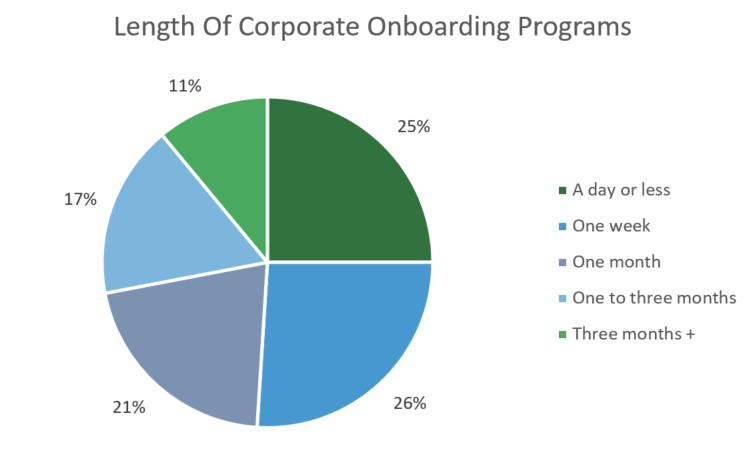
Image Credit: Panopto
A mere 28% of companies are actually investing enough time and effort in the onboarding process to make a significant impact on the business.
In this graph by Opm, it shows the ideal onboarding model and time periods, and the process that will make the most positive impact on the insurer’s bottom line:
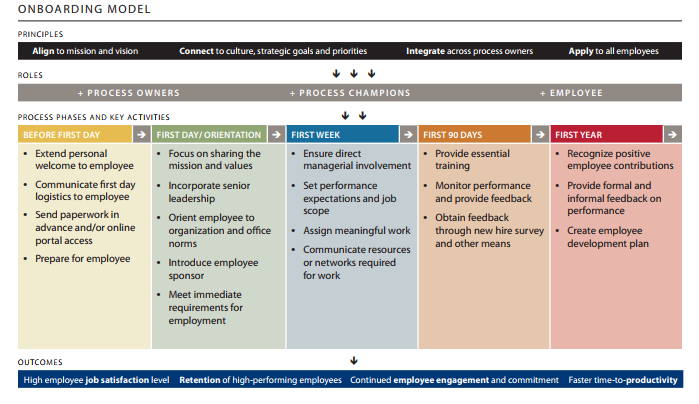
Image Credit: Opm.gov